Bamboo Cutting Board with Stand: Honest Review

The Astercook Deep-Carbonized Bamboo Cutting Board set earned a permanent spot on my counter after a Sunday charcuterie spread that ran three hours and left not a single knife mark I regretted.
There’s a specific kind of Sunday afternoon I live for. The kind where the counter gets completely taken over by a soft wedge of aged gouda, a fistful of prosciutto draped over the board’s edge, sliced cornichons, and a cheap bottle of something fizzy. My old plastic cutting board, warped at one corner and vaguely gray from years of dishwasher abuse, had been failing me at these moments for longer than I care to admit. So when the Astercook Deep-Carbonized Bamboo Cutting Board set landed on my doorstep in its slender box, I wasn’t expecting much. I was expecting a bamboo board. What I got was something that changed how I think about prep surface entirely.

The First Time I Used It
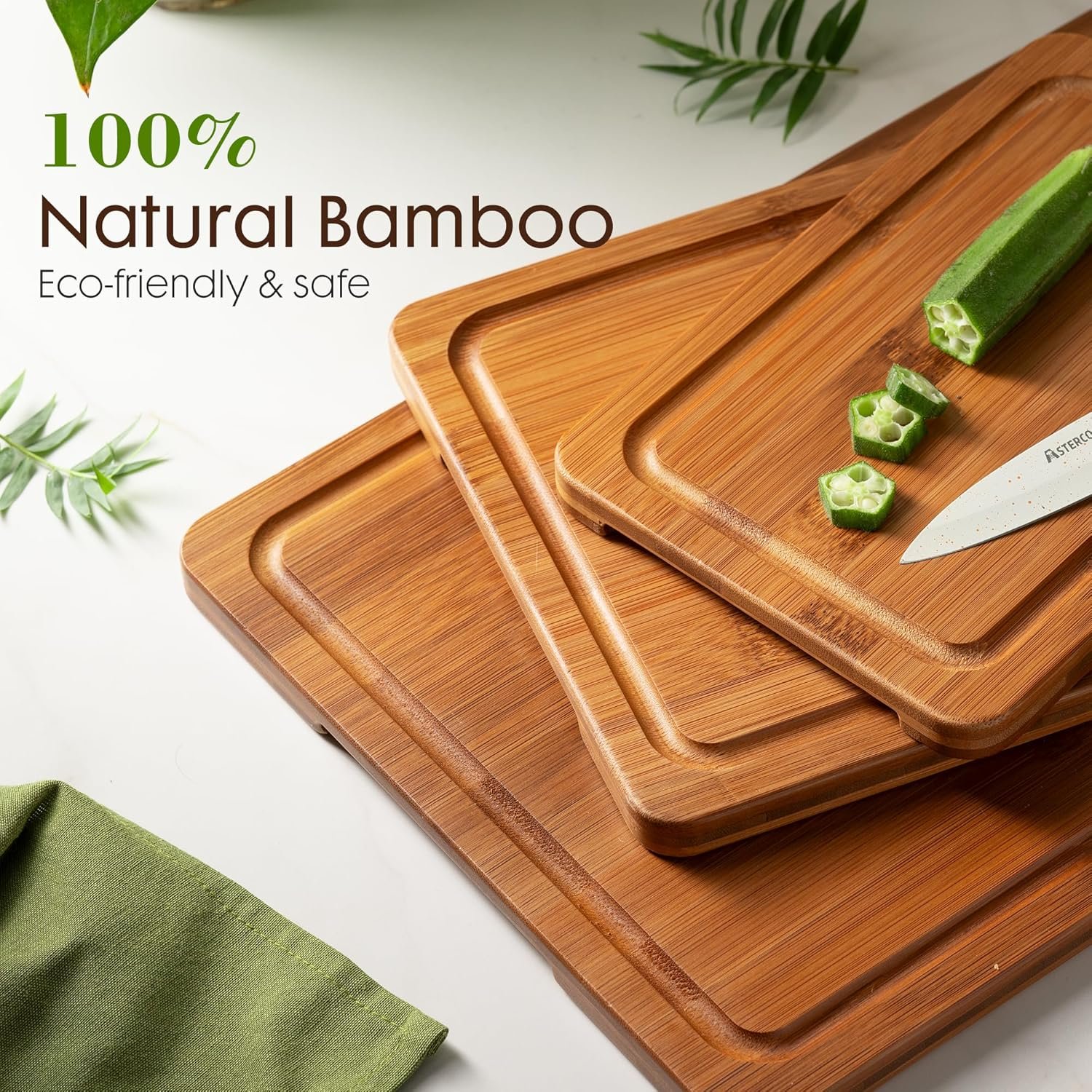
The first thing I noticed when I pulled the boards out was the color. Deep-carbonized bamboo has this rich, almost chocolatey tone that reads expensive in a way that’s hard to articulate when you’re just staring at a product photo online. The set comes with two boards of different sizes and a wooden storage stand, and they slotted into that stand so cleanly I left them right on the counter next to the stove, which is not something I do with cutting boards. Cutting boards live in a cabinet. These stayed out.
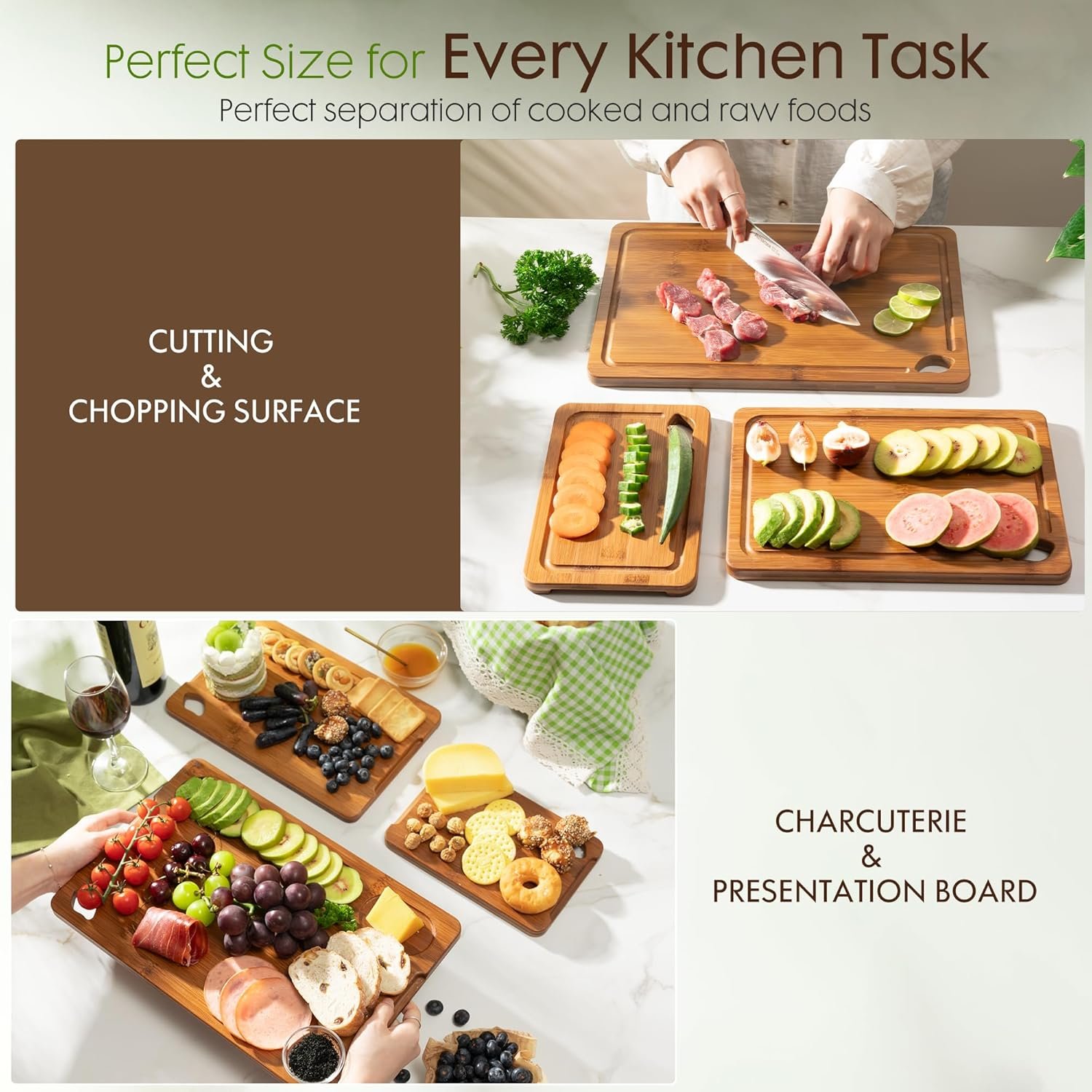
I used the larger board that same evening to break down a whole chicken. The surface had a satisfying matte grip, the easy-grip handles gave me something real to hold onto when I shifted it toward the sink, and the juice grooves on the perimeter caught every bit of runoff. I was curious enough to flip it over and try the other side on raw vegetables within the same meal, which is what reversible boards are actually for, and the logic of that design clicked immediately.
How It Actually Performs
Let me talk about the knife feel, because that’s everything with a cutting board. Bamboo sits at a medium hardness on the Janka scale, harder than most woods used for end-grain boards but softer than glass, ceramic, or the dense composite boards that quietly destroy your edges over months of daily use. On the Astercook surface, my eight-inch chef’s knife felt like it was landing somewhere intentional. Not too soft, not punishing. The board has a little give, which is exactly what you want when you’re doing repetitive cuts through herbs or shallots for twenty minutes straight.
“A cutting board shouldn’t announce itself, and this one doesn’t, which is the highest compliment I can offer.”
That said, bamboo is not a forgiving material if you let it dry out. After a few weeks of daily use, I noticed the edges beginning to show the faintest hint of dryness, the kind that precedes cracking if you’re not paying attention. A quick application of food-grade mineral oil solved it immediately. This is not unique to Astercook, it’s just a bamboo reality, and the Serious Eats kitchen equipment team has written extensively about bamboo and wood board care if you want the long version of why that maintenance step matters.


What I Actually Cooked With It
Use 1: Sunday Charcuterie and Cheese Board
This is where the Astercook cutting board review practically writes itself. I laid out a full spread across the larger board, using it as both a prep surface and a serving piece, which the carbonized finish makes genuinely possible. The dark tone makes pale cheeses pop, the juice grooves hold a little pool of honey without disaster, and the easy-grip handles meant I could carry the whole loaded board from counter to table without renegotiating my grip halfway across the kitchen. The reversible design meant I’d prepped the fruit and crackers on one side and served directly on the other. My guests assumed I’d bought a dedicated charcuterie board. I did not correct them.
Use 2: Weeknight Vegetable Prep for Sheet-Pan Dinners
On a Tuesday in late October I used the smaller board exclusively for a full week of weeknight cooking. Butternut squash. Sweet potatoes. A lot of onions. The juice groove system earned its keep every single night, especially with the squash, which releases an aggressive amount of liquid when you’re cutting through the flesh. The board didn’t slide, it didn’t warp from repeated exposure to wet vegetables, and it cleaned up with a quick hand-wash and dry without drama. For this kind of daily cutting board work, it performed without complaint.

Use 3: Holiday Bread and Carving Station
I pulled the large board out again for a holiday dinner where I needed a dedicated carving surface for a bone-in leg of lamb. The juice grooves handled the runoff impressively, the surface gave the carving knife something stable to work against, and the whole setup looked intentional on the table in a way that a white plastic board never would. Carrying a carved roast back to the kitchen on a board with real handles is a detail you don’t know you need until you’ve done it once. It is a legitimately better experience.
What Other People Are Saying
This product has accumulated thousands of reviews at an impressively high average rating, which at this price point is genuinely unusual for a set that includes a storage stand and two boards. The patterns in the feedback are consistent: people mention the handles, the appearance, and the grooves repeatedly and positively. The few lower ratings tend to center on oiling and maintenance, which suggests some buyers didn’t expect bamboo to require any care at all.
The consensus tells me this is a product that over-delivers on presentation and daily usability for most home cooks, and under-delivers only for people who want completely zero-maintenance prep surfaces. That’s a fair and honest trade-off to understand before buying.


Who Should Skip It
If you exclusively use a dishwasher for everything and have no interest in hand-washing or oiling a board, bamboo of any kind is not your material. Dishwasher heat and bamboo are genuinely incompatible over time, and the Astercook boards are no exception. If you’re working in a very small galley kitchen with no counter space and nowhere to store or display a stand, the storage stand becomes a liability rather than a feature. And if you regularly do high-volume butchering or heavy cleaver work, you want a thick end-grain board with more mass underfoot. This set is built for daily cooking and entertaining, not for serious protein breakdown at volume. For that specific need, you’d want to browse cutting board options by material and use-case before deciding.
What It Replaces in My Kitchen
Honestly? Three different things. A warped plastic board I’d been meaning to throw out for two years. A thin bamboo board I’d bought at a discount store that had no grooves and no handles and had cracked along one edge by month three. And a separate slate serving board I’d been using exclusively for cheese, which is now redundant because the carbonized surface reads just as sophisticated on a table. Having two boards that work as both prep tools and serving surfaces, stored neatly in a stand, simplified my counter situation in a way I didn’t anticipate. I also want to note, because it matters, that this set functions as a genuinely thoughtful gift for anyone who cooks. If you’re looking for kitchen gift ideas that feel considered rather than generic, this is the kind of thing that photographs well, performs well, and doesn’t collect dust.

For reference on how to think about knives and prep tools as a connected system, a good cutting board is one of the few purchases that affects every other tool you own. A bad surface dulls your knives. A board that slides wastes your attention. Getting this piece right has downstream effects on everything else.
FAQ
Does the surface hold up to daily knife use without significant scarring?
Yes, with normal use. Bamboo will show cut marks over time, as all boards do, but the carbonized surface is dense enough that scarring accumulates slowly. Surface marks don’t affect performance, but if you prefer a pristine-looking board indefinitely, no natural material will deliver that.
How do I clean and care for these boards?
Hand-wash with warm soapy water and dry immediately. Apply food-grade mineral oil or a dedicated board conditioner every few weeks, or whenever the surface starts to look dry or dull. Do not submerge in water and do not place in the dishwasher.
Are these boards safe for both raw meat and produce?
The reversible design is specifically intended for this. Use one face for proteins and the other for produce or bread, and keep the designation consistent. The bamboo surface is naturally lower in porosity than softwoods, which helps, but proper separation practice still applies.
Does the build quality match what you’d expect for an entry-level bamboo set?
It significantly exceeds expectations for this tier. The joinery on the boards is clean, the handles feel solidly integrated rather than glued-on, and the storage stand is stable and well-proportioned. The value reads noticeably above what you’d expect, which is why the rating from thousands of buyers skews so high and stays there.
Does the set come with any warranty or replacement option?
Astercook offers customer service support and a satisfaction guarantee on their products. For specifics on warranty terms, I’d recommend checking directly with the seller or retailer at time of purchase, as terms can vary by platform.


The Verdict
Six weeks after I first pulled these boards out of the box, they’re still on my counter in that wooden stand, which tells you everything about how this experiment went. I reach for the large board almost every day. The smaller one rotates in for quick jobs, fruit, herbs, a hunk of bread. The set feels like it belongs in a kitchen that takes food seriously without taking itself too seriously, which is exactly the register I’m always trying to hit. If you’ve been cooking on aging plastic or a single sad bamboo slab and you want something that does double duty as prep surface and serving piece, this is a straightforward answer. You’ll also want to explore our full editor recommendations if you’re outfitting a kitchen more broadly, and if you’re thinking about a complete prep system, our roundups on chef’s knife picks and knife set recommendations pair naturally with a board upgrade like this one. The America’s Test Kitchen equipment methodology on cutting boards is also worth a read if you want to go deeper before buying. This set won’t be right for every kitchen, but for the cook who preps real food every week, hosts occasionally, and wants a surface that looks intentional on a table, the Astercook Deep-Carbonized Bamboo Cutting Board set is one of the better answers at this price point. Buy it, oil it, use it daily, and stop thinking about cutting boards.
Every Angle
The product as photographed for Amazon — front, side, back, detail.


As an Amazon Associate I earn from qualifying purchases.