14-Piece Knife Block Set for Daily Cooking: Honest Review

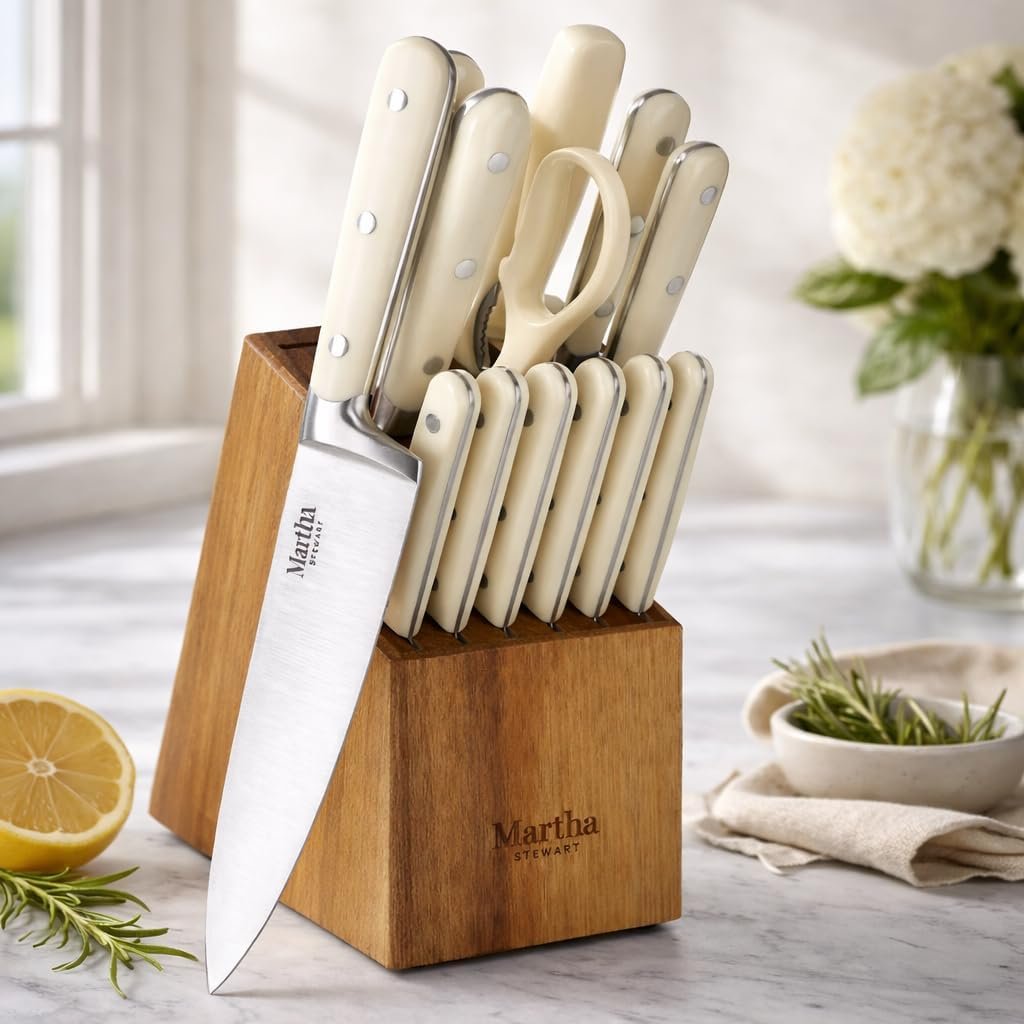
The Martha Stewart Eastwalk 14 Piece Knife Block Set landed on my counter on a Tuesday, and by Thursday I’d broken down a whole chicken, sliced a pound of heirloom tomatoes, and stopped reaching for my old knives entirely.
There is a particular kind of domestic confidence that comes from having the right knife in your hand. Not a precious knife, not a knife you’re afraid to actually use, but one that feels settled and purposeful, the kind you reach for when dinner needs to happen and you don’t have time to think about your tools. I’ve been cooking seriously for about fifteen years, and I’ve cycled through a depressing number of knife sets: the wedding-gift block that rusted at the bolster, the “professional” set that came dull from the box, the single Japanese santoku I babied so carefully it spent more time on the shelf than in rotation. So when the **Martha Stewart Eastwalk knife set** arrived in its flat-packed box, I’ll admit I didn’t have enormous expectations. I was wrong to be skeptical.

The First Time I Used It
I unboxed it on a Tuesday evening while I was already mid-prep for a weeknight stir-fry, which felt like a fair enough baptism. The acacia wood block went onto the counter. I pulled out the 8-inch chef’s knife, ran my thumb lightly across the edge, and made my first cut through a bell pepper. It went through cleanly, without that frustrating half-press, half-drag that dull knives demand. The triple-riveted handle sat in my palm with a solidity that I wasn’t expecting at this price point.
I kept cutting. By the time the wok was hot, I’d sliced two peppers, minced a full head of garlic, and julienned a knob of ginger, and the blade had stayed precise through all of it. That was the moment I understood I was dealing with something more thoughtful than the average entry-level knife set. The real question was whether that first-night sharpness would hold.
How It Actually Performs
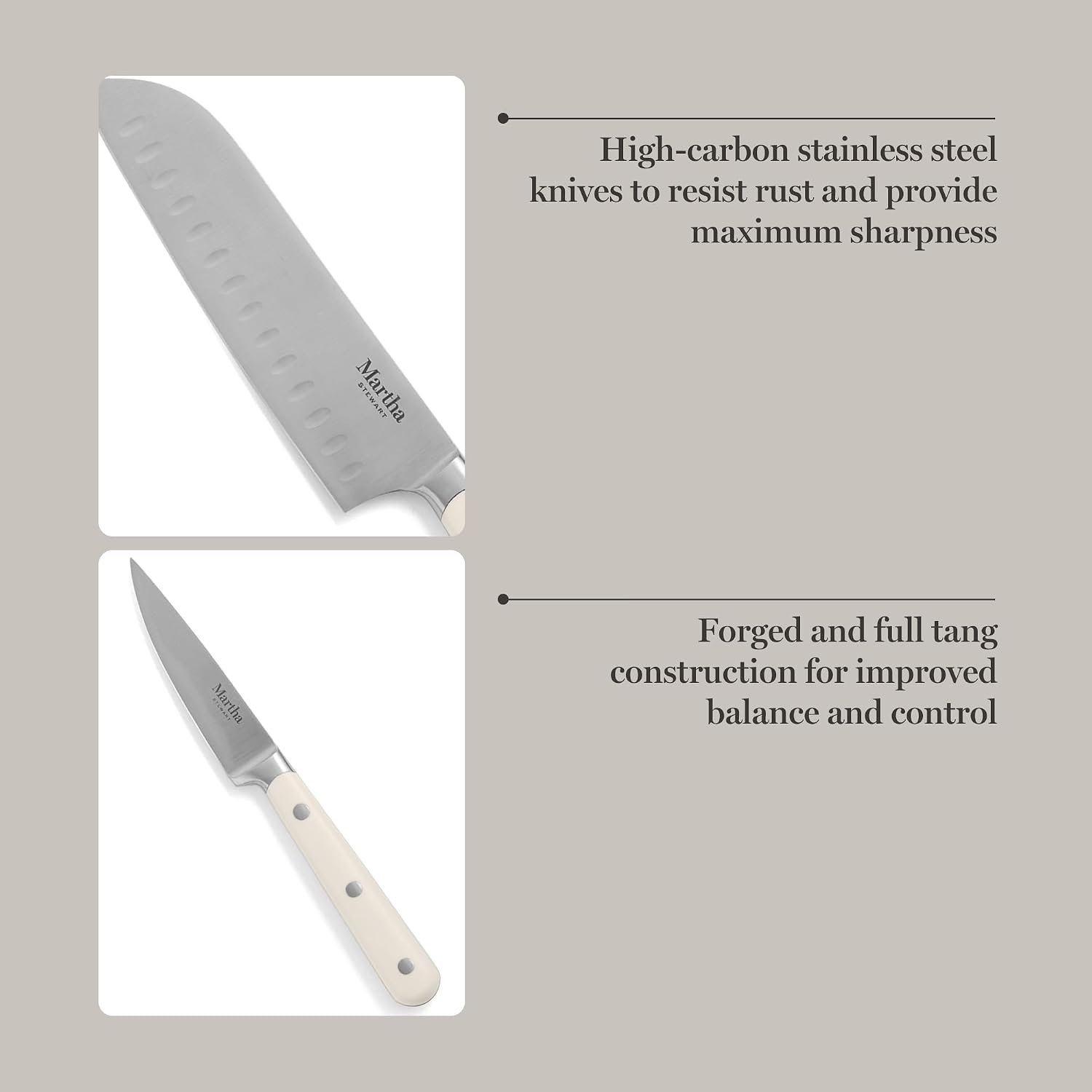
The blades on this set are high-carbon stainless steel, which is the meaningful detail that separates a knife worth owning from one worth pitying. High-carbon steel takes and holds a sharper edge than standard stainless, while the stainless component resists the corrosion and staining that plagued older high-carbon blades. In practice, this means you get knives that start sharp and, with minimal maintenance, stay that way. The chef’s knife, the workhorse of any knife set, has the kind of blade geometry that makes rocking cuts feel natural rather than effortful.
“This is the knife set for the cook who wants to actually cook, not curate.”
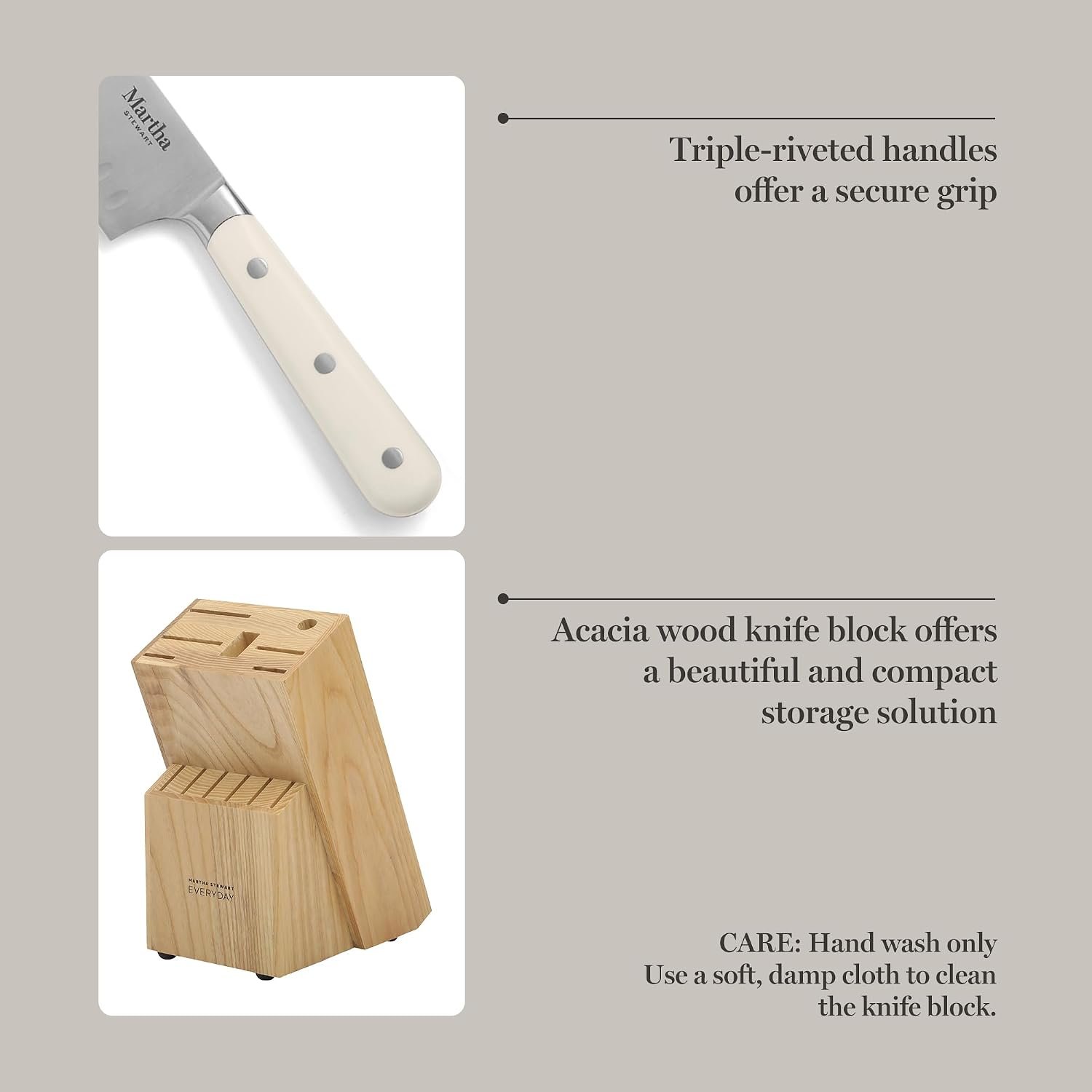
The handles deserve their own sentence. **ABS triple-riveted construction** is not a decorative choice, it’s a functional one. The three rivets distribute stress across the handle so the blade tang doesn’t flex or loosen with regular use. My one honest caveat: the handles are a polished finish, which looks clean and modern but can get slick when your hands are wet or greasy. It’s worth keeping a dish towel nearby during heavy prep sessions. For a deeper look at what makes handle construction matter in a chef’s knife, the Serious Eats equipment review archive has some of the most rigorous blade testing I’ve encountered outside a professional cutlery shop.


What I Actually Cooked With It
Use 1: Breaking Down a Whole Chicken
This is my standard test for any new knife set, because it asks multiple blades to do difficult, specific things. I used the chef’s knife for the initial cuts through the skin and joint connective tissue, then switched to the included boning knife for the precision work around the thigh bones. The boning knife has a narrower, slightly flexible blade that allowed me to follow the bone closely without tearing the meat. **I lost almost no usable chicken**, which if you’ve ever hacked through a bird with an inadequate knife, you know is the whole victory.
Use 2: Weekend Tomato Situation
It was a Saturday in early fall, the kind of day when the farmers market produces a haul of tomatoes in every color and you need to slice a lot of them for a lazy lunch. The serrated bread knife that comes in this knife set handled heirloom tomatoes with a sureness that made me genuinely happy. No squishing, no skin dragging, just clean slices that held their shape on the plate. For what you’re paying, getting a serrated knife this capable alongside the chef’s knife feels like a genuine surplus of value.

Use 3: Holiday Cookie Prep
Hear me out: the 3.5-inch paring knife became my unlikely favorite during a December afternoon of cutting dried fruit and shaping marzipan. Small, controlled cuts are where paring knives either earn their place or confirm they’re filler pieces in a set. This one earned its place. The blade tapered predictably, the grip was secure even when I was working quickly, and the size felt proportional to the task in a way that I don’t always find in set paring knives, which often feel either too stubby or too long. It’s the knife I didn’t know I needed until I was using it.
What Other People Are Saying
This product launched without a broad independent review trail from major kitchen-testing publications, so the picture of its real-world performance comes primarily from home cooks rather than professional testers.
That’s actually useful signal. With over two thousand verified ratings averaging out to four-and-a-half stars, the pattern in owner feedback is consistent: sharpness out of the box and the acacia block’s visual appeal come up constantly, and so does the durability of the riveted handles after months of daily use. Home cooks tend to be honest about disappointment, especially at an accessible price tier, so that consensus reads as genuine satisfaction rather than hype.


Who Should Skip It
If you live in a studio apartment where counter space is your most constrained resource, a 14-piece knife block is going to feel like a commitment you didn’t sign up for. The acacia block is beautiful, but it’s not small. You’d be better served by a magnetic wall strip and two or three carefully chosen individual knives from our chef’s knife picks. Similarly, if you are deeply committed to Japanese-style thin-blade geometry, this set won’t satisfy that itch. These are Western-style blades with a slightly thicker spine, built for the rocking and push-cut techniques that dominate most home Western cooking.
And if you’re a strict dishwasher-only household: **hand wash these, please.** High-carbon stainless steel and dishwasher detergent have a rocky relationship. The heat and harsh chemistry can accelerate edge degradation and dull the polish on the handles faster than you’d like. If that’s a firm dealbreaker for you, factor it in honestly before purchasing.
What It Replaces in My Kitchen
For years I ran a kitchen held together by three orphaned knives from three different sets and a bread knife I’d bought at a garage sale because it was sharp and cost almost nothing. It worked, technically. But there was always a moment of hesitation when I reached for a knife, a half-second calculation about which one was least inadequate for the job. That hesitation is gone now. The Eastwalk set gave me a complete, coherent system where each knife has a defined role and performs it reliably.
The acacia block also replaced a ceramic crock that had been my knife storage solution, and I didn’t realize until I made that swap how much I preferred being able to see which knife I was reaching for. **Small organizational wins matter when you cook every day.** You can explore the rest of our thinking on organized prep setups in our cutting board and prep surface recommendations, which pair naturally with a full knife block overhaul.

FAQ
How sharp do these knives come out of the box?
Sharper than most entry-level knife sets I’ve tested. The chef’s knife and the paring knife in particular arrive with a working edge that most home cooks will find immediately useful, though a few passes on a honing steel before first use is always a good habit.
How should I care for and clean these knives?
Hand wash with warm soapy water and dry promptly, every time. High-carbon stainless steel can develop surface spots if left wet, and prolonged moisture exposure at the bolster can compromise the handle bond over years of use. A light honing before each session keeps the edge in rotation.
Are these knives safe to put in the dishwasher or use on induction?
These are manual cutting tools, so induction compatibility isn’t a relevant question here, but the dishwasher question is: no, not recommended. The repeated exposure to high heat and alkaline detergent will dull the blades and can warp or crack the ABS handles over time.
Does the build quality match what Martha Stewart’s brand promises?
The triple-riveted full-tang construction and the high-carbon blade material read as well above what you’d expect for the value this set delivers. The acacia block in particular feels like something that belongs in a kitchen two tiers above this one. Longevity will depend on maintenance, but the bones of this set are solid.
Does this set come with a warranty or replacement knife options?
Martha Stewart’s kitchen product line is backed by a manufacturer’s limited warranty, though exact terms vary by retailer. It’s worth registering the product after purchase and keeping your receipt for any warranty claims, particularly on the block, which is the component most subject to cosmetic wear over time.


The Verdict
I keep the Eastwalk block at the end of my counter now, close enough to reach without moving my feet. That proximity is the best evidence I have that it earned its place. I’ve reached for the chef’s knife more than any other blade I own over the past two months, and the edge has held well with regular honing and hand washing. The America’s Test Kitchen framework for evaluating knives, which prioritizes blade geometry, handle comfort, and long-term edge retention, maps closely to what this set delivers at an accessible price tier. It’s not the knife set for someone building a professional-grade prep station. But for the home cook who wants a complete, well-designed knife set that looks good on the counter and actually gets used every night, this is a very confident recommendation.
If you’re considering it as a gift, it photographs beautifully and ships as a complete system, which makes it one of the cleaner choices in our kitchen gift guide. And if you want to compare it against individual picks before committing to a full set, our knife sets category has the context you need. For anyone building out a complete knives and prep kitchen setup from scratch, this is a strong place to start, and the fuller picture of our editor-recommended kitchen tools will help you round out the rest. The build quality reads above what you’d expect for the investment, the acacia block is genuinely lovely, and the knives actually do what knives are supposed to do. **This is the knife set you buy when you’re ready to stop making do.**
Every Angle
The product as photographed for Amazon — front, side, back, detail.

As an Amazon Associate I earn from qualifying purchases.